Global bond markets are experiencing one of their most difficult periods in years as government borrowing costs climb sharply across the United States, Europe, Japan and other major economies.
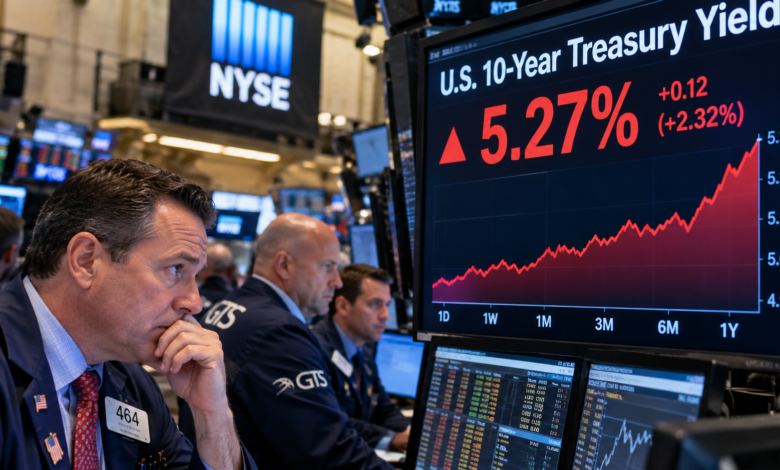
The global bond market selloff intensified during September 2026, pushing the benchmark 10-year U.S. Treasury yield above 5% and briefly past 5.27%, its highest level in roughly 19 years.
The rise in yields is being driven by a combination of persistent inflation concerns, elevated energy prices, strong economic activity, large government borrowing needs and expectations that central banks may keep interest rates higher for longer.
Because government bond yields influence everything from mortgages to corporate loans, the latest market moves could have significant consequences for consumers, companies and financial markets worldwide.
What Is Causing the Global Bond Market Selloff?
Several forces are hitting bond markets at the same time.
Investors had previously expected inflation to continue easing and central banks to gradually move toward lower interest rates.
Instead, rising oil prices, resilient economic growth and renewed inflation concerns have forced markets to reconsider that outlook.
Bond prices generally fall when investors believe interest rates will remain high or move higher.
When bond prices fall, their yields rise.
That relationship is at the center of the current market turbulence.
September has been particularly difficult for government debt. U.S. two-year Treasury yields rose by nearly 60 basis points during the month, their largest monthly increase since early 2023, while yields also climbed sharply across major European markets.
U.S. 10-Year Treasury Yield Climbs Above 5.27%
The benchmark U.S. 10-year Treasury yield has become one of the clearest indicators of the selloff.
On September 29, the yield remained close to 5.2% after briefly moving above 5.27%, a level not seen for approximately 19 years.
The yield had risen by almost half a percentage point during September alone.
That is a significant move for the world’s largest government bond market.
U.S. Treasury yields are widely used as reference rates throughout global finance.
When they rise, borrowing costs can increase for:
- Homebuyers
- Businesses
- Governments
- Credit-card borrowers
- Auto-loan customers
- Emerging-market countries
- Corporate bond issuers
This means a Treasury selloff can quickly spread beyond financial markets and affect the wider economy.
30-Year Treasury Yield Hits Multi-Decade High
Longer-term U.S. government bonds have experienced even greater pressure.
During the recent selloff, the 30-year Treasury yield climbed to around 5.48%, its highest level since 2004.
Long-term yields are especially important because they reflect investor expectations about inflation, government borrowing and economic conditions over many years.
When investors demand significantly higher yields to hold long-term bonds, it can indicate growing uncertainty about future inflation and fiscal conditions.
It can also push borrowing costs higher across other parts of the economy.
Rising Oil Prices Add to Inflation Concerns
Energy prices are one of the biggest factors complicating the outlook.
Brent crude has been trading above $100 per barrel amid geopolitical tensions and concerns about global energy supplies.
Higher oil prices can increase costs throughout the economy.
Transportation companies need more money for fuel.
Manufacturers may pay more for energy and raw materials.
Airlines face higher operating expenses.
Consumers can also face more expensive gasoline, transportation and household products.
If businesses pass those costs on to customers, inflation can remain elevated.
That makes it harder for central banks to reduce interest rates.
For bond investors, the possibility of prolonged inflation means fixed-interest payments become less attractive, encouraging investors to demand higher yields.
Strong U.S. Economy Complicates the Rate Outlook
Normally, investors might expect central banks to lower rates when borrowing costs become restrictive.
But strong economic activity is complicating that expectation.
The U.S. economy has continued to show resilience, particularly in employment, consumer activity and technology investment.
This has increased expectations that the Federal Reserve may need to maintain restrictive monetary policy to ensure inflation remains under control.
Investors are now watching upcoming employment and inflation reports for signs of whether additional monetary tightening could be required.
Strong economic growth is usually positive news.
However, when inflation is already elevated, strong demand can create additional price pressure.
That creates an unusual situation in which positive economic data can sometimes cause bond prices to fall.
AI Investment Boom Adds Another Pressure
The artificial intelligence investment boom is also playing a role in financial markets.
Large technology companies are spending enormous amounts of money on data centers, chips, electricity infrastructure and cloud computing.
Some companies are financing part of those investments by issuing corporate debt.
Technology-related corporate bond issuance has exceeded $200 billion in 2026, increasing the amount of debt competing for investor capital.
When corporations issue large amounts of bonds at the same time that governments are also borrowing heavily, investors have more choices.
Bond issuers may consequently have to offer higher yields to attract buyers.
That can put additional upward pressure on borrowing costs.
Government Debt Is Becoming a Bigger Market Concern
Government borrowing is another important factor behind the global bond market selloff.
The United States and several other major economies continue to operate with large budget deficits.
Governments finance deficits partly by selling bonds.
When the supply of government debt increases significantly, markets must find enough investors willing to purchase it.
If demand does not increase at the same pace, bond prices may fall and yields may rise.
U.S. government debt has exceeded $40 trillion, while fiscal concerns have become an increasingly important topic among bond investors.
Similar concerns exist in parts of Europe and Japan.
This means investors are not only thinking about central-bank interest rates. They are also evaluating whether governments will need to issue increasingly large amounts of debt in the coming years.
European Bond Yields Are Rising Too
The selloff is not limited to the United States.
Government bond yields have risen sharply across Europe.
France’s 10-year government bond yield has approached levels last seen around the 2008 financial crisis, while German and British borrowing costs have also moved higher.
Higher yields create challenges for European governments because interest expenses can consume a larger share of national budgets.
Countries with large debt burdens can be particularly sensitive.
If governments must spend more money servicing existing and new debt, they may have less flexibility for other priorities.
That can eventually lead to difficult decisions involving taxes, public spending or additional borrowing.
Japan Also Faces Multi-Decade-High Yields
Japan’s bond market is another important part of the global story.
Japanese government bond yields have climbed toward levels not seen for decades as the country adjusts to changing inflation and monetary-policy conditions.
Japan maintained extremely low interest rates for many years.
As its monetary environment normalizes, rising Japanese yields could affect global markets because Japanese investors hold significant amounts of foreign assets.
If domestic Japanese bonds become more attractive, some investors could potentially reduce overseas investments and move funds back into Japan.
That could influence U.S. and European bond demand.
Why Bond Prices Fall When Yields Rise
For new investors, bond-market terminology can sometimes be confusing.
Bond prices and bond yields generally move in opposite directions.
Imagine an existing government bond pays a fixed amount of interest.
If newly issued bonds begin offering higher returns, investors will be less interested in buying the older bond at its original price.
The older bond’s market price therefore falls until its effective yield becomes competitive with newer bonds.
This means:
Bond prices fall → yields rise
and
Bond prices rise → yields fall
So when financial headlines describe a “bond selloff,” they usually mean investors are selling bonds, pushing their prices lower and yields higher.
Mortgage Rates Could Stay Expensive
One of the most direct effects on consumers is through mortgages.
U.S. mortgage rates are closely influenced by longer-term Treasury yields.
As Treasury yields have climbed, 30-year U.S. mortgage rates have moved to around or above 7%.
Higher mortgage rates can significantly increase monthly payments.
For example, even if a home’s purchase price remains unchanged, a buyer financing it at 7% will pay considerably more each month than a buyer with a 4% mortgage.
That can reduce home affordability and slow housing-market activity.
Potential buyers may delay purchases, while existing homeowners with low fixed-rate mortgages may become reluctant to move because replacing their current loan would mean accepting a much higher rate.
Businesses Face More Expensive Financing
Companies are also affected by rising bond yields.
Large corporations often borrow money by issuing bonds.
If government bonds already offer attractive yields with relatively low credit risk, companies must generally offer even higher rates to persuade investors to buy corporate debt.
This increases the cost of financing.
Businesses may respond by delaying:
- Factory expansions
- New offices
- Acquisitions
- Technology investments
- Hiring plans
- Equipment purchases
Small businesses may feel the impact through bank lending rates rather than corporate bonds.
When banks face higher funding costs, business loans can also become more expensive.
High Bond Yields Put Pressure on Stock Valuations
The global bond market selloff can also affect stock markets.
When government bond yields are very low, investors often accept higher stock valuations because alternatives provide limited returns.
But when Treasury bonds offer yields above 5%, that calculation changes.
Investors can potentially earn meaningful returns from government securities without accepting the same level of risk associated with stocks.
This can make high stock valuations harder to justify.
Growth and technology stocks can be particularly sensitive because much of their valuation depends on profits expected many years into the future.
Higher interest rates reduce the present value investors assign to those future earnings.
Despite this pressure, technology shares have recently shown resilience because enthusiasm around artificial intelligence remains strong.
Emerging Markets Face Additional Challenges
Higher U.S. Treasury yields can create particular difficulties for emerging markets.
When investors can earn more from U.S. government debt, they may become less willing to hold assets in countries considered riskier.
This can lead to capital moving toward the United States.
The resulting flows may strengthen the U.S. dollar while weakening emerging-market currencies.
Indonesia provides a recent example.
The rupiah moved beyond 18,000 per U.S. dollar on September 29 as higher U.S. yields and rising oil prices pressured regional currencies.
Countries that import large amounts of oil can face an additional challenge because energy purchases become more expensive.
Stronger Dollar Adds Pressure Around the World
Higher U.S. yields have also supported the dollar.
A stronger dollar can create problems for companies and governments that borrowed money in the U.S. currency.
If their domestic currency weakens, it takes more local currency to repay the same dollar-denominated debt.
This can increase financial stress in developing economies.
A stronger dollar can also make commodities priced in dollars more expensive for foreign buyers.
That can amplify the impact of already-high energy prices.
Bond Market Volatility Jumps
The rapid change in interest-rate expectations has also increased bond-market volatility.
Reuters reported that the ICE BofA MOVE Index, a widely watched measure of Treasury-market volatility, had risen by around 30% during September.
Higher volatility means investors face greater uncertainty about where yields will move next.
That can make financial institutions more cautious and may widen the gap between borrowing and lending rates.
It can also increase hedging costs for companies trying to protect themselves against changing interest rates.
Are Higher Bond Yields Always Bad?
Higher yields are not negative for everyone.
For savers and income-focused investors, higher government bond yields can provide attractive opportunities.
Investors who previously struggled to earn meaningful returns from relatively low-risk assets may now find Treasury securities more appealing.
Retirement funds, insurance companies and income investors can potentially lock in higher yields.
However, investors should remember that existing bond prices can decline when yields continue rising.
The attractiveness of higher yields therefore depends partly on an investor’s time horizon and willingness to hold bonds until maturity.
What Could End the Bond Selloff?
Several developments could eventually stabilize bond markets.
One would be a clear decline in inflation.
If inflation falls consistently toward central-bank targets, policymakers could become more comfortable lowering interest rates.
Lower oil prices could help as well.
A slowdown in economic growth could also reduce expectations for future rate hikes.
Bond markets would additionally benefit from stronger investor demand at government debt auctions.
However, if inflation remains persistent, energy prices stay high and governments continue borrowing heavily, yields could remain elevated.
What Investors Are Watching Next
Markets are now focused on several major factors.
U.S. employment data: Strong job growth could reinforce expectations that the Federal Reserve can maintain high rates.
Inflation reports: Persistent inflation could increase pressure for additional monetary tightening.
Oil prices: Further energy-price increases could worsen inflation expectations.
Federal Reserve signals: Investors will watch speeches and policy decisions for clues about future rates.
Government debt auctions: Weak demand could push yields even higher.
European budgets: Fiscal developments in France and the United Kingdom will remain important.
Corporate debt issuance: Heavy borrowing from technology and AI companies could continue competing with government bonds for investor money.
Could U.S. Treasury Yields Go Even Higher?
The recent move above 5% has caused investors to reconsider levels that once appeared unlikely.
Some market participants are now discussing whether long-term Treasury yields could move toward 6% if inflation and economic growth remain strong.
That is not a certainty.
Bond markets can change direction quickly when economic data surprises investors.
A sharp economic slowdown, falling oil prices or weaker inflation could send yields lower.
For this reason, investors should view current yield levels as part of a highly uncertain environment rather than assuming rates will continue moving in only one direction.
Global Bond Market Selloff: The Bigger Picture
The global bond market selloff represents more than a temporary move in financial markets.
It reflects a major debate over what the normal level of interest rates may look like in the years ahead.
For much of the period following the 2008 financial crisis, investors became accustomed to extremely low borrowing costs.
The current environment looks very different.
Inflation risks, higher government debt, energy-market uncertainty and huge investment requirements for artificial intelligence and infrastructure may all contribute to keeping capital more expensive.
If that continues, governments, companies and households may need to adapt to a world where borrowing at very low rates is no longer normal.
Conclusion
The global bond market selloff has pushed U.S. Treasury yields to levels not seen for nearly two decades and increased borrowing costs across the global economy.
The U.S. 10-year Treasury yield has moved above 5%, while the 30-year yield recently reached its highest level since 2004.
Rising oil prices, inflation concerns, resilient economic growth, large government borrowing programs and heavy corporate debt issuance are all contributing to the pressure.
For consumers, the consequences include expensive mortgages and other loans.
For companies, higher yields can make investment and expansion more costly.
For governments, larger interest payments can put additional pressure on budgets.
Investors will now closely watch employment, inflation, energy prices and central-bank decisions to determine whether the bond selloff continues or begins to stabilize.
With borrowing costs near multi-decade highs, developments in the bond market are likely to remain one of the most important financial stories heading into the final quarter of 2026.