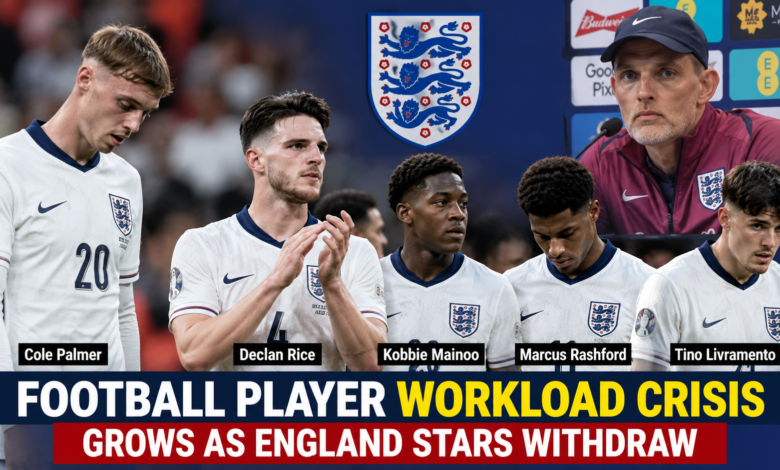
Football Player Workload Crisis Grows as England Stars Withdraw
Concerns over football’s increasingly crowded calendar have intensified after five England players withdrew from the national squad during the September 2026 international window.
Cole Palmer, Declan Rice, Kobbie Mainoo, Marcus Rashford and Tino Livramento were all unavailable because of injury or fitness issues, significantly reducing manager Thomas Tuchel’s options for England’s UEFA Nations League matches.
Their absences have added fresh momentum to the debate surrounding the football player workload crisis, with Professional Footballers’ Association chief executive Maheta Molango arguing that the modern schedule is pushing elite players beyond sustainable physical limits.
The issue extends far beyond England. Players across Europe’s biggest leagues are dealing with domestic competitions, European tournaments, international football and expanded global competitions with increasingly limited periods for rest and recovery.
Five England Players Withdraw From Nations League Squad
England began the September international period with a substantially weakened squad after losing five players.
Chelsea midfielder Cole Palmer withdrew with a minor muscular problem.
Arsenal’s Declan Rice was also unavailable following years of heavy match exposure and ongoing fitness management.
Manchester United players Kobbie Mainoo and Marcus Rashford were ruled out after their club match against Fulham, while Newcastle defender Tino Livramento suffered another setback after returning from a calf injury.
Morgan Gibbs-White and James Garner were subsequently called into the squad as replacements.
The withdrawals arrived as England prepared for a demanding Nations League window that included fixtures against Spain, Czechia and Croatia.
PFA Says Football Calendar Is Pushing Players Too Far
The Professional Footballers’ Association has used the England situation as further evidence of a wider problem.
PFA chief executive Maheta Molango said Palmer’s withdrawal highlighted what happens when elite footballers are exposed to continuous club and international commitments.
Speaking during the FIFPRO and Cleveland Clinic Peak Performance & Health Summit in London, Molango argued that football must recognize players’ physical limits rather than assuming they can continually absorb more matches.
His argument is not simply about the number of games.
Player workload also involves travel, interrupted sleep, insufficient recovery periods, training demands and accumulated physical and mental fatigue. FIFPRO’s workload monitoring work specifically tracks those factors alongside match schedules.
Cole Palmer Becomes Central to Workload Debate
Cole Palmer has become one of the most prominent examples in the discussion.
The Chelsea attacker was recalled by England after missing the 2026 World Cup squad but withdrew before the Nations League campaign because of a muscular issue.
Palmer had started the club season strongly, recording four goals and two assists in his opening seven appearances before the England camp.
His recent schedule has also been unusually demanding.
FIFPRO noted earlier in 2026 that players such as Palmer were facing a third consecutive year without a substantial traditional summer recovery period because of Euro 2024, the 2025 FIFA Club World Cup and the 2026 FIFA World Cup.
That sequence illustrates one of the central concerns raised by player representatives: even when the number of matches appears manageable over an individual month, the cumulative effect across several seasons can become significant.
Declan Rice’s Workload Shows the Scale of the Problem
Declan Rice provides another striking example.
The Arsenal midfielder made 69 appearances for club and country last season and had been managing neural back and hamstring discomfort.
Rice said earlier in September that he believed playing more than 60 matches in a season was sustainable for him, although Arsenal continued to monitor his physical condition carefully.
The decision was ultimately made for Rice to sit out England’s latest international period.
Even Tuchel, who has generally resisted widespread rotation during international windows, acknowledged that Rice needed rest because of his accumulated workload and fitness history.
His situation highlights the difficulty facing managers.
Elite players want to represent both club and country, while clubs and national teams naturally want their strongest footballers available.
But every additional match reduces the time available for physical recovery.
Some Players Could Exceed 70 Matches Per Season
FIFPRO has repeatedly warned about players reaching exceptionally high appearance totals.
Earlier in 2026, the organization said several elite footballers were on course to play more than 70 matches during the 2025-26 season when club and international competitions were combined.
This level of activity can include:
- Domestic league matches
- Domestic cup competitions
- UEFA Champions League or Europa League games
- International qualifiers
- Nations League fixtures
- Major international tournaments
- FIFA Club World Cup matches
- Pre-season tours and friendlies
The concern is not necessarily that every professional footballer plays 70 games.
Rather, the heaviest burden tends to fall on a relatively small group of elite players who regularly advance deep into multiple competitions.
Those are often the same stars expected to appear in the biggest matches for both their clubs and national teams.
Expanded Competitions Add More Fixtures
Football’s calendar has changed considerably in recent years.
Competition formats have expanded as governing bodies and leagues attempt to provide more high-profile matches.
The UEFA Champions League expanded its league phase.
The FIFA Club World Cup became a much larger tournament.
International competitions and qualification schedules also continue throughout club seasons.
These competitions generate substantial commercial value through broadcasting, sponsorship and ticket sales.
However, each additional match must fit into a calendar that still contains roughly the same number of weeks.
The result is increasingly compressed recovery time between major events.
Players Need More Than Days Without Matches
One misconception in the workload discussion is that a player who does not have a competitive match automatically receives proper rest.
Professional footballers continue training between fixtures.
They also travel internationally, undergo tactical preparation, complete media obligations and participate in recovery work.
FIFPRO’s performance experts emphasize that travel, disrupted sleeping patterns, mental stress and accumulated fatigue all contribute to player workload.
Long-distance international travel can be particularly demanding.
A player may finish a club match, fly to join a national team, train, play multiple international fixtures and then return directly to club competition.
There may be very little opportunity for a genuine physical and psychological break.
FIFPRO Calls for Minimum Rest Safeguards
Player representatives have proposed minimum recovery standards as one possible solution.
FIFPRO has argued for safeguards including a minimum four-week summer break followed by sufficient pre-season preparation before competitive football resumes.
The organization also wants discussions about:
- Minimum rest periods
- Off-season breaks
- Recovery windows
- Time between matches
- International travel
- Overall annual workload
FIFA and FIFPRO reached an agreement in 2026 giving player representatives a formal role in future discussions over workload standards and international calendars beyond 2030.
This suggests the workload debate is moving beyond public criticism toward negotiations over formal rules.
Injury Risk Is a Major Concern
The central issue is player health.
Football demands repeated sprinting, rapid changes of direction, tackling, jumping and high-intensity movement.
Muscles and joints require recovery time after these stresses.
When fixtures arrive every few days for extended periods, players may have less time to recover fully before competing again.
FIFPRO performance experts have warned that long sequences of matches combined with international travel can increase physical and mental strain.
Not every injury can be blamed on fixture congestion.
Football injuries can result from collisions, individual biomechanics, previous injuries, training incidents and simple bad luck.
But player unions argue that inadequate recovery is an important risk factor that football authorities should address.
England Is Not the Only Team Dealing With Injuries
The current problem extends beyond Tuchel’s England squad.
Molango also pointed to injuries affecting other leading European internationals when discussing the issue, arguing that repeated absences of elite players should concern everyone involved in football.
Club teams face the same challenge.
Managers frequently have to decide whether to use their strongest players in consecutive league, European and cup fixtures or rotate and potentially weaken the team.
At the highest level, even one or two dropped points can affect title races or qualification.
That competitive pressure encourages teams to keep selecting their best players whenever they are available.
Thomas Tuchel Rejects Widespread Rotation
Interestingly, England manager Thomas Tuchel has pushed back against suggestions that international coaches should simply rotate heavily to protect club players.
Ahead of England’s Nations League matches, Tuchel described the idea of allowing clubs or players to determine which international games they participate in as unreasonable.
He argued that England needs continuity and a stable core of players rather than constantly changing the team.
This demonstrates why the workload debate is so difficult to solve.
National-team managers have limited opportunities to work with players.
If they rest stars during those windows, they may struggle to build tactical understanding.
Club managers face exactly the same problem during crucial domestic fixtures.
Simply asking individual coaches to rotate therefore does not solve the structural issue of how many matches exist.
Fans Also Lose When Stars Are Injured
Player welfare is not the only concern.
Molango argues that supporters ultimately lose when elite footballers cannot play because of injuries or accumulated fatigue.
Fans purchase tickets and subscriptions expecting to watch leading players.
A major England fixture without Palmer, Rice, Rashford and several other established players is a different product from one featuring the strongest available squad.
The same problem applies to club football.
When stars miss Champions League, Premier League or major cup matches, the quality and commercial appeal of those competitions can suffer.
This creates a potential contradiction.
Adding more matches may generate additional short-term revenue, but excessive workload could reduce the quality of those matches if leading players are unavailable or unable to perform at their best.
Performance Can Drop Before an Injury Happens
Workload is not only about whether a player becomes officially injured.
Fatigue can affect performance before a medical problem appears.
A tired player may:
- Sprint less effectively
- React more slowly
- Make poorer decisions
- Lose technical precision
- Struggle with concentration
- Recover more slowly between high-intensity efforts
These small differences matter significantly at elite level.
A footballer does not need to suffer a serious injury for an overloaded schedule to influence the quality of a match.
This is why performance specialists increasingly focus on both injury prevention and maintaining optimal performance.
Young Players May Face Particular Risks
The growing number of young footballers playing at elite level creates another workload question.
Teenagers can now become first-team regulars at major European clubs while also representing national youth or senior teams.
Their careers may therefore accumulate heavy workloads much earlier than previous generations.
FIFPRO has highlighted younger players as an area requiring particular attention when discussing minimum workload safeguards.
The objective is not necessarily to restrict talented young players from competing.
Instead, player representatives argue that development should include sufficient recovery and carefully managed workloads.
Club Versus Country Tension Remains
The England withdrawals also highlight the long-standing tension between clubs and national teams.
Premier League clubs pay players’ salaries and naturally want them healthy for domestic competition.
National teams, meanwhile, have only a handful of international windows each season.
When a player arrives carrying a minor injury, both sides may have different priorities.
Clubs may prefer rest.
National coaches may believe the player can still contribute.
Performance experts have identified this misalignment between club and international football as one of the challenges created by a congested calendar.
Better communication may help, but it cannot completely resolve the issue when both teams have important matches.
The 2026 World Cup Added Another Heavy Summer
The expanded football calendar became particularly challenging in 2026 because leading players had another major international tournament during the summer.
England reached the World Cup semi-finals before losing to Argentina.
Players involved in the latter stages therefore had limited time between a long club campaign, World Cup participation and the beginning of another domestic season.
Several England players returned immediately to clubs with significant competitive expectations.
This is exactly the kind of repeated season-to-tournament-to-season cycle that player unions say reduces genuine recovery time.
Football’s Commercial Growth Creates a Difficult Trade-Off
The reason schedules continue expanding is easy to understand.
Football has enormous global demand.
Broadcasters want more major games.
Sponsors want more exposure.
Supporters want opportunities to watch their teams.
Clubs and governing bodies benefit financially from additional competitions.
Those revenues can support wages, infrastructure, academies and football development.
The debate therefore is not simply about eliminating matches.
Instead, football faces the difficult task of finding a calendar that preserves commercial growth without undermining the players who generate much of that value.
FIFPRO Europe has argued that players, clubs and leagues should have greater formal involvement in decisions affecting football’s calendar and working conditions.
Could Squad Rotation Solve the Problem?
Rotation helps, but it has limitations.
Large clubs may have enough depth to rest several players while remaining competitive.
Smaller teams often do not.
International teams also have limited preparation opportunities and naturally want their strongest lineup for important fixtures.
Supporters purchasing expensive tickets may additionally be disappointed if leading players are repeatedly rested.
This is why player unions argue that the solution needs to come from calendar design rather than simply expecting coaches to manage impossible schedules.
Technology Can Help Monitor Workload
Modern clubs collect enormous amounts of physical-performance data.
GPS devices can measure distance, sprinting, acceleration and high-intensity movement.
Medical teams can also monitor sleep, muscle condition and recovery.
These systems allow coaches to identify players who may be approaching dangerous fatigue levels.
But technology has limits.
Data can tell clubs that a player needs rest.
It cannot create additional recovery days when another important match is scheduled 72 hours later.
Ultimately, workload monitoring is most effective when teams have enough calendar flexibility to act on the information.
Football Authorities Face Growing Pressure
The workload debate is increasingly becoming a governance issue.
FIFPRO and player associations want more involvement in decisions about competition structures.
In September 2026, FIFPRO Europe again raised player workload and working-time safeguards during meetings with European policymakers in Brussels.
This suggests the discussion is unlikely to disappear.
As new competitions expand and existing tournaments become larger, players and unions are likely to continue demanding clearer protections.
What Could Change?
Several ideas are being discussed across football.
Possible approaches include stronger minimum rest periods, protected summer breaks, better coordination between club and international schedules and limits on extremely congested sequences of games.
Another possibility is ensuring players receive proper pre-season conditioning before beginning competitive matches.
FIFPRO has emphasized that a meaningful off-season break should be followed by enough preparation time rather than players returning directly from holidays into major matches.
Any solution will require cooperation between clubs, leagues, national associations, UEFA, FIFA and player organizations.
That makes reform complicated but not impossible.
England Injuries Put Workload Debate Back in Spotlight
The withdrawals of Palmer, Rice, Mainoo, Rashford and Livramento do not by themselves prove that every injury was caused by fixture congestion.
Each player has an individual medical situation.
However, five withdrawals from one elite national squad provide a timely example of the broader concern being raised by football’s player representatives.
The PFA’s argument is that the sport should not wait until injuries become even more common before addressing structural workload problems.
The issue is particularly relevant when players are moving almost continuously between club and international competition.
Football Player Workload Crisis: What Happens Next?
The football player workload crisis is likely to remain one of the sport’s biggest debates throughout the 2026-27 season.
Several questions remain unresolved.
Can competitions continue expanding without increasing injury risk?
How much annual rest should elite footballers receive?
Should clubs or national teams have priority when a player’s fitness is uncertain?
Should there be mandatory minimum recovery periods between matches?
And how much influence should players themselves have over the international calendar?
There is no simple answer.
Every competition has commercial and sporting reasons for wanting its strongest possible schedule.
But the same small group of elite players cannot participate in unlimited matches.
Conclusion
England’s latest injury withdrawals have renewed scrutiny of the football player workload crisis.
Cole Palmer, Declan Rice, Kobbie Mainoo, Marcus Rashford and Tino Livramento all withdrew from Thomas Tuchel’s squad during the September Nations League window.
PFA chief executive Maheta Molango says the situation illustrates a wider problem in which elite footballers are being pushed beyond sustainable limits by an increasingly crowded calendar.
FIFPRO has already warned that some players can face more than 70 appearances across club and international football, while also calling for stronger minimum rest and recovery safeguards.
The debate is therefore no longer simply about whether players feel tired.
It concerns injuries, long-term careers, performance quality and the future structure of elite football.
As clubs, national teams and governing bodies continue competing for space in the calendar, finding a sustainable balance between more football and healthier players is becoming increasingly important.