US Troops Leave Iraq in 2026 as Two-Decade Military Era Ends
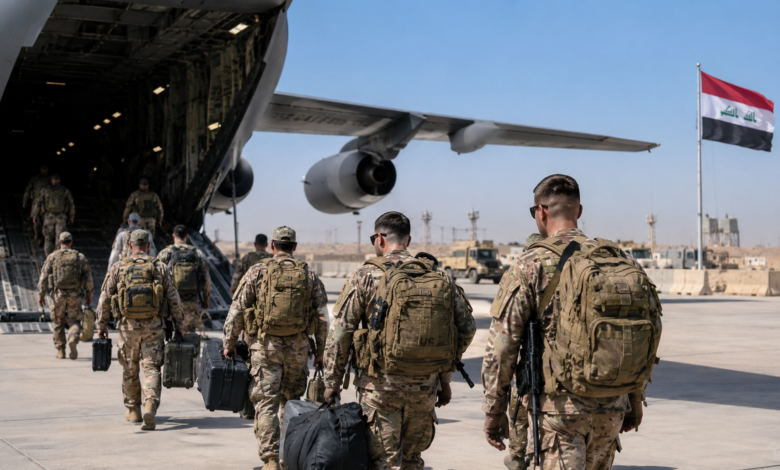
U.S. forces are preparing to leave their final military bases in Iraq, marking the end of the latest phase of an American military presence that has shaped Iraqi politics and security for more than two decades.
The remaining U.S. forces are expected to depart their last bases by September 30, 2026, completing a withdrawal process agreed between Washington and Baghdad in 2024.
The departure represents an important moment for Iraq, which has spent years balancing close relationships with both the United States and neighboring Iran.
For many Iraqis, the withdrawal represents another step toward full national sovereignty. Others are concerned about whether Iraqi security forces can prevent Islamic State cells from rebuilding their capabilities and whether Iran-aligned armed groups could gain additional influence.
The US troops leave Iraq 2026 story is therefore about much more than troops physically departing military bases. It could influence Iraq’s security, its political direction and the wider balance of power across the Middle East.
When Are U.S. Troops Leaving Iraq?
The remaining U.S. forces are set to leave their final bases in Iraq by September 30, 2026.
Reuters reported on September 29 that American forces were preparing to complete their departure under an agreement originally reached in 2024.
That agreement created a phased transition from the U.S.-led coalition’s military mission.
The original U.S.-Iraq plan called for the coalition’s military mission inside Iraq to conclude by the end of September 2025 while allowing support for operations against Islamic State in northeastern Syria from locations in Iraq to continue through September 2026, subject to conditions and consultation.
The latest withdrawal therefore completes the second phase of that transition.
U.S. Military Presence in Iraq Has Lasted More Than Two Decades
The history of American forces in Iraq has not been continuous, but it stretches back more than 20 years.
U.S.-led forces invaded Iraq in 2003, overthrowing President Saddam Hussein.
The invasion was followed by years of conflict involving insurgent groups, sectarian violence and attacks on coalition forces.
American forces formally withdrew at the end of 2011.
However, they returned less than three years later after Islamic State captured large areas of Iraq and neighboring Syria.
From 2014 onward, American forces worked alongside Iraqi security forces and an international coalition to defeat Islamic State’s territorial control.
The group lost the territory it had controlled in Iraq by 2017, although smaller cells continued operating.
Why Did U.S. Forces Return in 2014?
Islamic State’s rapid expansion created a major security crisis for Iraq.
At its peak, the extremist organization controlled roughly one-third of the country and captured cities including Mosul.
The Iraqi government requested international assistance.
The United States and other coalition members provided air power, intelligence, training, logistical assistance and military advisers to Iraqi forces.
Iraqi government troops, Kurdish Peshmerga forces and other armed groups eventually pushed Islamic State out of its territorial strongholds.
After the group’s territorial defeat, the U.S. mission increasingly shifted away from direct combat and toward training, advising and supporting Iraqi forces.
Why Are U.S. Troops Leaving Now?
The withdrawal is the result of negotiations between the Iraqi and U.S. governments rather than a sudden decision.
In September 2024, Washington and Baghdad announced a transition plan designed to end the coalition’s formal military mission and move toward a different bilateral security relationship.
At the time, U.S. officials stressed that the process was intended to reflect improved Iraqi security capabilities.
The first phase concluded the coalition’s military mission in Iraq.
The second phase allowed Iraq to continue supporting coalition operations against Islamic State in neighboring Syria until September 2026.
With that period now ending, U.S. troops are leaving the remaining bases associated with the mission.
Iraq Wants Greater Control Over Its Own Security
Sovereignty has remained central to the debate over foreign troops in Iraq.
Many Iraqi political groups have long argued that the country should control its own security without permanent foreign military forces.
Reuters reported that the eventual departure is broadly popular among Iraqis, although views differ significantly over whether the timing is right.
Supporters see the withdrawal as evidence that Iraq is capable of taking responsibility for its own national defense.
Critics worry that removing external military support could expose weaknesses in intelligence gathering, air surveillance and logistical capabilities.
Both arguments are likely to remain part of Iraq’s domestic political debate after the final American forces leave.
Iran Welcomes the U.S. Withdrawal
Iran has openly welcomed the American departure.
Tehran has consistently opposed the presence of U.S. forces in neighboring Iraq and has supported political and armed groups that favor their removal.
Iranian officials and Iran-aligned Iraqi groups have described the withdrawal as a strategic success.
Iran already maintains substantial political, economic and security relationships inside Iraq.
The two countries share a long border, extensive trade ties and religious connections.
Iran also has relationships with several powerful Iraqi Shi’ite armed factions.
The U.S. departure could therefore change the balance among Iraqi political and security actors.
Could Iran Gain More Influence in Iraq?
Some Iraqi analysts believe Iran-aligned groups could attempt to strengthen their position once U.S. forces are gone.
Iraqi security analyst Jasim al-Bahadli told Reuters that the American military presence had acted as one counterweight to Tehran’s influence.
However, Iran’s future influence will depend on more than the presence or absence of American troops.
Iraq has its own political institutions, competing parties, religious authorities and security forces.
Many Iraqi leaders also seek relationships with the United States, Gulf countries, Turkey and other international partners.
Baghdad has repeatedly attempted to balance those relationships rather than align completely with one regional power.
Iran-Backed Groups Call Withdrawal a Victory
Some armed factions aligned with Iran have publicly celebrated the departure.
A commander from the Islamic Resistance in Iraq described September 30 as the closing of what he viewed as a period of foreign occupation.
Those statements reflect a long-running political position among several Iraqi militias.
U.S. forces and Iran-aligned groups have repeatedly exchanged attacks during periods of regional tension.
Washington has accused some Iraqi armed factions of carrying out attacks against American personnel and regional partners with Iranian support.
The Iraqi government has said it is working to limit armed activity that operates outside state control.
Islamic State Remains a Security Concern
Another major question is whether Islamic State could exploit the withdrawal.
The organization no longer controls major cities or large territories in Iraq, but security officials say sleeper cells remain active.
Some Iraqi and Kurdish officials have warned that reduced access to American intelligence, surveillance and logistical support could create opportunities for militants.
Kurdish commander Sirwan Barzani told Reuters that officials had noticed increased movement by suspected Islamic State sleeper cells as the withdrawal approached.
Iraqi security officials have also reported disrupting suspected plots linked to the group.
These developments do not necessarily mean Islamic State is capable of recreating the territorial organization it controlled a decade ago, but they demonstrate why counterterrorism remains an important concern.
Iraqi Forces Are Stronger Than They Were in 2014
Iraq’s security forces have developed significantly since Islamic State’s 2014 offensive.
The country now has greater combat experience, stronger counterterrorism units and more developed military institutions.
The United States previously cited improved Iraqi capabilities as one reason the coalition mission could transition.
Iraq also maintains multiple security organizations, including the regular armed forces, federal police, Counter Terrorism Service and Kurdish Peshmerga forces.
The key question is whether those organizations can maintain effective intelligence and coordination without the same level of coalition support.
U.S.-Iraq Relations Will Not Necessarily End
The departure of American troops does not mean diplomatic relations between Washington and Baghdad are ending.
The United States and Iraq maintain political, economic and security ties under their broader bilateral relationship.
When the transition plan was announced in 2024, U.S. officials said they expected cooperation with Iraq to continue beyond the coalition mission, potentially including training, military equipment and counterterrorism cooperation.
The exact shape of future security cooperation may continue to evolve.
Washington also maintains significant economic and diplomatic relationships with Baghdad.
The military withdrawal should therefore be understood as a change in the form of U.S. involvement rather than necessarily the end of the broader relationship.
Iraq Has Tried to Balance Washington and Tehran
Few countries have faced the same geopolitical balancing challenge as Iraq.
The United States has played an important role in Iraq’s security institutions and international relationships.
Iran, meanwhile, is Iraq’s neighbor and has extensive political, religious, economic and military connections inside the country.
At times, tensions between Washington and Tehran have turned Iraqi territory into an arena for confrontation.
One of the most significant examples occurred in January 2020, when a U.S. strike near Baghdad International Airport killed Iranian General Qasem Soleimani.
Iran-backed groups subsequently intensified pressure on the American military presence.
Iraqi governments have repeatedly sought to prevent their country from becoming a battlefield between foreign powers.
Security Vacuum Is the Main Concern for Some Iraqis
Not everyone believes the withdrawal should have happened at this stage.
Some Sunni political and tribal figures, particularly in areas that suffered heavily during the rise of Islamic State, worry about a possible security gap.
Abdulrahman al-Zobaie, a tribal leader from Fallujah, told Reuters that Iraqis support sovereignty but that concerns remain about whether the country’s security institutions are fully prepared to take over every responsibility previously supported by the coalition.
Fallujah itself has particular historical significance.
The city became one of the main centers of resistance to U.S.-led forces after the 2003 invasion and later experienced severe violence during the Islamic State conflict.
Residents there have lived through several different phases of Iraq’s security crisis.
Kurdish Regions Will Also Watch the Transition Closely
Security in northern Iraq is another area to watch.
Kurdish Peshmerga forces played a major role in the campaign against Islamic State and worked closely with coalition forces.
The semi-autonomous Kurdistan Region also hosted U.S. personnel and military facilities.
ISIS cells remain active in some disputed and rural areas between Kurdish and federal security zones.
Effective coordination between Baghdad and Kurdish authorities will therefore be especially important after the withdrawal.
Weak coordination could create spaces that extremist groups attempt to exploit.
Regional Conflict Makes the Timing More Complicated
The American departure comes during an unusually volatile period in the Middle East.
The United States and Iran are engaged in a wider regional confrontation in 2026, making Iraq’s position particularly sensitive.
Reuters reported that Iran views the Iraq withdrawal as part of its broader objective of reducing the American military presence across the Middle East.
At the same time, the United States has accused Iran-backed groups in Iraq of participating in regional attacks.
This means the troop withdrawal is occurring while Washington and Tehran remain in direct strategic competition.
How Iraq manages that rivalry could become one of the most important questions for its government.
What Does the Withdrawal Mean for Iraqi Politics?
The end of the U.S. military presence may influence domestic politics as well as security.
Political parties and armed groups that campaigned for American forces to leave are likely to present the withdrawal as an achievement.
Other factions may focus more heavily on maintaining security cooperation with Western governments.
The change could also intensify debate over the role of militias that operate alongside or outside Iraq’s formal armed forces.
Baghdad has repeatedly faced pressure to bring weapons and security decisions under greater state control.
With foreign troops leaving, demands for stronger centralized control over armed groups could grow.
Could U.S. Forces Return Again?
Iraq’s recent history shows that military arrangements can change when security conditions change.
American combat forces left Iraq in 2011 but returned in 2014 after Islamic State captured large areas of the country.
That does not mean another return is expected.
However, future Iraqi governments could request international assistance if a serious security threat develops.
Any future deployment would depend on political decisions by Iraq, the United States and other partners.
For now, the focus is on Iraq assuming greater responsibility for its own security.
What Happens After September 30?
Once the final withdrawal is completed, attention will shift to several key questions.
Observers will watch whether Islamic State activity increases, whether Iran-aligned groups expand their political or security influence and whether Iraqi forces can maintain stability without the same level of U.S. military support.
Baghdad’s relationships with both Washington and Tehran will also remain important.
Another area to monitor will be cooperation between federal Iraqi forces and Kurdish security organizations.
The success or failure of the transition will likely become clearer over months and years rather than immediately after the final troops leave.
US Troops Leave Iraq 2026: A Major Historical Moment
The departure represents another major turning point in the long and complicated history between Iraq and the United States.
The U.S.-led invasion began in 2003.
American troops withdrew in 2011.
They returned in 2014 to support the fight against Islamic State.
Now, in September 2026, forces are leaving the final bases associated with that mission.
For Washington, the withdrawal closes a major military chapter.
For Iraq, it begins a period in which domestic security institutions will carry greater responsibility.
For Iran and its Iraqi allies, it removes a long-standing American military presence from a neighboring country where Tehran has substantial influence.
And for Islamic State, Iraqi officials will be watching closely for any attempt to exploit the transition.
Conclusion
The US troops leave Iraq 2026 withdrawal marks one of the most significant changes in Iraq’s security landscape in years.
American forces are expected to leave their final bases by September 30, completing the phased transition agreed by Washington and Baghdad in 2024.
The withdrawal is welcomed by many Iraqis who view it as an important step toward full sovereignty.
At the same time, Iraqi and Kurdish security officials have raised concerns about Islamic State sleeper cells, while some analysts expect Iran-aligned political and armed groups to seek greater influence.
The long-term consequences remain uncertain.
Much will depend on whether Iraqi forces can maintain security, whether Baghdad can manage competing domestic armed groups and how Iraq balances its relationships with both the United States and Iran.
What is clear is that September 30, 2026 will mark the end of another major chapter in a U.S.-Iraq military relationship that has shaped the Middle East for more than two decades.