Meta Expands Enterprise AI Push as Business Software Competition Heats Up

Meta Expands Enterprise AI Push as Business Software Competition Heats Up
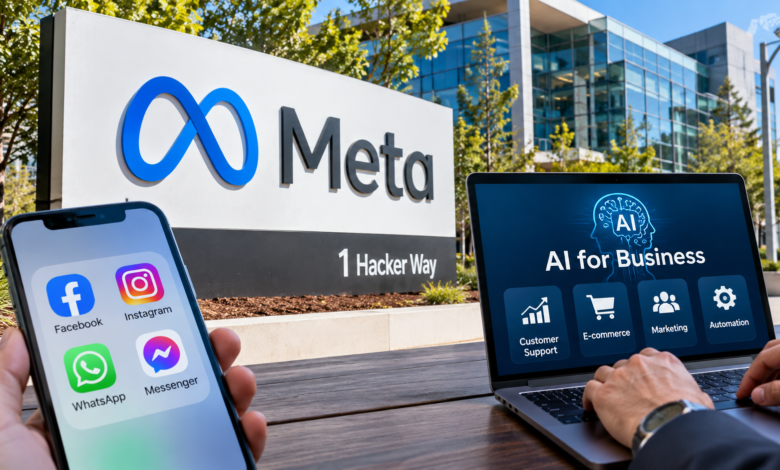
Meta is making a bigger push into the enterprise artificial intelligence market as the technology giant looks for new ways to bring AI tools to businesses.
The company has recruited Chirantan “CJ” Desai, the chief executive of MongoDB, to lead its newly created enterprise platform operation.
Desai will serve as Meta’s chief enterprise platform officer and report directly to CEO Mark Zuckerberg, according to Reuters. His role will focus on transforming Meta’s growing collection of artificial intelligence technologies into practical products that companies can use in their daily operations.
The move signals that Meta is looking beyond consumer social media and advertising as it competes for a larger share of the rapidly growing enterprise AI market.
Meta Strengthens Its Enterprise AI Strategy
Meta has spent heavily on artificial intelligence infrastructure, models and consumer AI products in recent years.
Now, the company appears increasingly interested in bringing those technologies directly into workplaces.
Its new enterprise platform initiative is expected to bring together products such as Meta’s AI models, Muse AI agent, Meta Business Agent tools and coding technologies into services that businesses can deploy.
Meta also announced additional business-focused capabilities during its recent Meta Connect event.
Its Business Agent Platform is designed to help companies deploy AI agents through messaging services, allowing businesses to capture leads, assist customers and potentially complete sales within conversations.
This could create a significant opportunity for Meta because millions of businesses already communicate with customers through Facebook, Instagram, Messenger and WhatsApp.
Meta Hires MongoDB CEO to Lead Enterprise Platform
One of the clearest signs of Meta’s enterprise ambitions is the appointment of CJ Desai.
Desai previously led MongoDB, a major database software company used by developers and enterprises around the world.
Before MongoDB, he held senior leadership positions at companies including Cloudflare and ServiceNow.
His experience in enterprise software could help Meta develop products designed specifically for companies rather than individual consumers.
According to Reuters, Desai will oversee efforts to convert Meta’s AI technologies into enterprise-ready solutions.
The appointment also had an immediate impact on MongoDB.
MongoDB shares dropped sharply following news of Desai’s departure, while former CEO Dev Ittycheria returned as interim chief executive.
Muse AI Becomes Part of Meta’s Business Expansion
Meta’s recently launched Muse AI agent is also becoming an important part of the company’s broader AI strategy.
Muse was introduced in September 2026 as an AI assistant capable of completing tasks such as sending emails, making bookings and handling transactions.
The company is now expanding Muse for small businesses.
New integrations include tools such as Shopify, QuickBooks, Stripe and Canva.
These integrations could allow small-business owners to use AI for tasks including:
- Managing online sales
- Handling accounting workflows
- Processing payments
- Creating marketing materials
- Supporting customers
- Automating repetitive business tasks
Instead of using several separate applications manually, companies could increasingly rely on AI agents to connect different services and complete tasks automatically.
Why Meta Wants Enterprise AI Customers
Enterprise software represents a major revenue opportunity.
Businesses are increasingly spending money on AI tools that can increase employee productivity, automate customer support, analyze company data and simplify administrative work.
Meta has traditionally generated most of its revenue from advertising.
Moving deeper into enterprise AI could help the company diversify its business model.
Subscriptions, enterprise software contracts, AI infrastructure services and developer platforms could potentially provide additional revenue sources beyond advertising.
Reuters reported that Meta’s expansion of Muse for businesses is part of the company’s broader effort to create new revenue streams.
Competition in Enterprise AI Is Growing
Meta will enter a highly competitive market.
Technology companies are racing to become the main providers of AI tools used inside businesses.
The enterprise AI market already includes major technology companies and specialist AI developers offering assistants, coding tools, automation platforms and AI infrastructure.
Competition increasingly centers on AI agents.
Unlike traditional chatbots that mainly answer questions, AI agents are designed to perform actions on behalf of users.
For example, an enterprise AI agent could potentially:
- Respond to customer inquiries
- Create reports
- Analyze sales information
- Update databases
- Schedule meetings
- Process transactions
- Assist software developers
This shift from AI assistants toward autonomous agents could reshape the enterprise software industry.
Meta Has a Major Distribution Advantage
One advantage Meta already has is its massive global network.
Businesses around the world already use Facebook, Instagram and WhatsApp to communicate with customers, advertise products and generate leads.
Meta’s Business Agent Platform aims to build AI capabilities directly into these communication channels.
Meta says businesses and users exchange more than one billion messages per day through its business messaging ecosystem.
That existing audience could make it easier for Meta to introduce AI tools without requiring companies to completely change the platforms they already use.
For small companies, this could be particularly important.
A local retailer, online seller or service company may already communicate with customers through WhatsApp or Instagram.
Adding an AI agent into the same workflow could allow the business to provide automated responses, qualify leads and assist customers around the clock.
Meta Expands AI Tools for Developers
Meta is also strengthening the technology available to software developers.
At Meta Connect 2026, the company announced that its Meta Model API had become generally available globally.
It also introduced updates to its Muse Spark models and Muse Code tools designed for coding and agent-based workflows.
Giving developers access to these technologies could help Meta build a larger ecosystem around its AI platform.
Developers could potentially create specialized AI applications for industries such as retail, finance, marketing, customer service and e-commerce.
What This Means for Small Businesses
Small businesses could become an important target market for Meta Enterprise AI.
Many smaller companies cannot afford large customer-service teams or expensive custom software.
AI agents could provide a lower-cost method of automating some of these tasks.
For example, an online store could potentially use an AI assistant to answer product questions, recommend items and assist customers with purchases.
A marketing agency could use AI to analyze advertising performance and generate campaign ideas.
A service business could use an AI agent to collect customer information and schedule appointments.
However, businesses will still need to consider important issues such as data privacy, security, accuracy and the level of human supervision required.
AI Could Change the Enterprise Software Industry
Meta’s expansion highlights a broader shift taking place across the technology industry.
Traditional business software has generally required employees to open individual applications and manually perform tasks.
AI agents could change this model.
Instead of navigating several applications, a worker may eventually give an AI agent an instruction and allow the system to perform tasks across multiple business tools.
This could affect software categories such as customer relationship management, accounting, marketing automation and customer support.
Software companies may increasingly compete based on how effectively their platforms allow AI agents to complete real-world business tasks.
Meta Looks Beyond Social Media
Meta remains one of the world’s largest social media and digital advertising companies, but its latest investments show that it wants AI to become a larger part of its future business.
The company is investing in AI models, infrastructure, consumer assistants, business agents and developer tools.
The appointment of an experienced enterprise software executive provides another indication that Meta is serious about competing for business customers.
Its existing social platforms could also give the company a strong distribution channel for introducing new AI services.
Outlook for Meta Enterprise AI
Meta’s enterprise AI strategy is still developing, and its long-term success will depend on how businesses respond to the company’s new products.
Companies will likely evaluate factors including reliability, cost, security, integrations and productivity benefits before adopting AI agents at scale.
Competition will also remain intense as major technology companies continue investing heavily in enterprise artificial intelligence.
Still, Meta’s combination of AI technology, business messaging platforms and a massive global user base gives the company several potential advantages.
As Meta turns more of its AI research into commercial business products, enterprise software could become one of the company’s most important new growth areas.
The coming years will show whether Meta can transform its strength in social media into a major position in the global enterprise AI market.