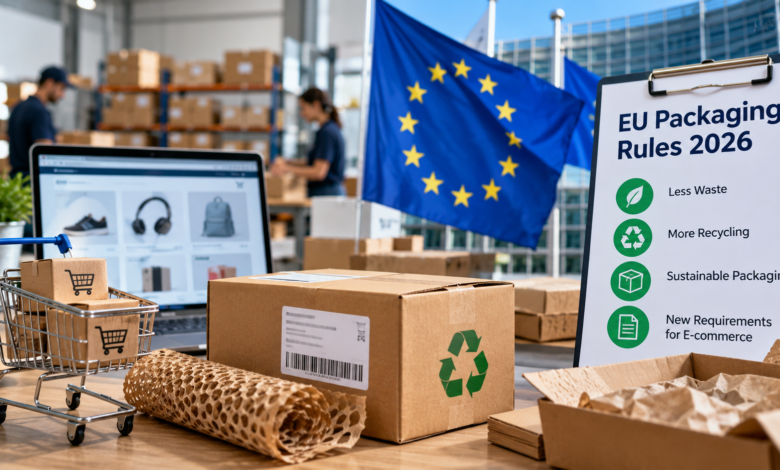
EU Packaging Rules 2026 Reshape E-Commerce and Small Businesses
New European Union packaging rules are beginning to change how companies package and sell products across Europe, creating new compliance requirements for e-commerce businesses, manufacturers and international exporters.
The EU’s Packaging and Packaging Waste Regulation (PPWR) generally began applying on August 12, 2026, replacing much of the previous packaging directive framework.
The regulation covers packaging placed on the EU market and is designed to reduce unnecessary waste, increase recycling, encourage reuse and create more consistent packaging standards across EU countries.
For online sellers and small businesses, the changes could affect everything from shipping-box design and packaging materials to product labels and cross-border compliance.
What Are the New EU Packaging Rules?
The Packaging and Packaging Waste Regulation establishes common rules covering the full life cycle of packaging.
Instead of relying mainly on different national packaging requirements, the EU is moving toward a more harmonized system.
The European Commission says the regulation applies across the EU from August 12, 2026 and is intended to reduce packaging waste while also making cross-border business easier through common rules.
The regulation covers packaging regardless of material or origin, although many of its major requirements are being introduced gradually rather than all at once.
This means businesses should view 2026 as the beginning of a broader transition rather than a single deadline.
Why the EU Changed Its Packaging Laws
Europe generates enormous amounts of packaging waste each year.
Packaging is used to protect products during transportation, improve shelf life and make products easier to sell, but excessive packaging also consumes raw materials and generates significant waste.
The European Commission has warned that without further action, packaging waste in the EU could grow by around 19% by 2030, while plastic packaging waste could increase by as much as 46%.
The PPWR is intended to change that trend by encouraging businesses to use less material, improve recyclability and increase the use of recycled resources.
The regulation also seeks to create a more circular economy in which packaging materials remain in use for longer rather than being discarded after a single use.
EU Packaging Rules Apply to Imported Products Too
One important issue for international businesses is that the regulation is not relevant only to companies physically located inside the European Union.
Packaging requirements can also apply to products imported and placed on the EU market.
That makes the regulation particularly important for exporters selling products from countries in Asia, North America, the Middle East and other regions to European customers.
An online business shipping packaged products into Europe may therefore need to determine whether its packaging meets applicable EU requirements.
The European Union has already been working with exporters outside Europe to improve understanding of the rules.
For example, an EU-supported initiative in Sri Lanka noted in August 2026 that the PPWR creates requirements affecting packaging used for goods exported to the European market.
New PFAS Restrictions Are Already Applying
One of the most immediate changes involves certain chemicals in food-contact packaging.
Beginning August 12, 2026, food-contact packaging containing PFAS above specified limits cannot be placed on the EU market.
PFAS are a group of highly persistent chemicals sometimes used to make packaging resistant to grease, oil or water.
They have historically been found in products such as:
- Fast-food wrappers
- Pizza boxes
- Bakery paper
- Takeaway containers
- Microwave popcorn packaging
The new limits mean businesses selling packaged food in Europe need to pay closer attention to the materials used by their packaging suppliers.
For restaurants, food manufacturers and international food exporters, verifying packaging composition could become increasingly important.
E-Commerce Packaging Faces Special Requirements
Online retail is specifically affected by some elements of the new framework.
E-commerce commonly involves products being placed inside larger shipping boxes, sometimes with substantial unused space.
The EU wants companies to reduce this unnecessary packaging.
From January 1, 2030, businesses filling e-commerce, grouped or transport packaging will generally have to ensure that the maximum empty-space ratio does not exceed 50%.
That could encourage retailers to use shipping boxes that more closely match the size of the products they contain.
Companies may also increasingly use:
- Adjustable cardboard boxes
- Paper-based protective materials
- Right-sized packaging technology
- Recyclable mailers
- Reusable delivery packaging
For large online retailers, packaging optimization could become a significant logistics project.
For smaller sellers, it may mean reviewing packaging sizes and suppliers well before the 2030 deadline.
Packaging Labelling Will Also Change
Another significant development involves labels.
The EU plans to introduce harmonized packaging labels designed to make it easier for consumers to understand what packaging is made from and how it should be sorted for recycling.
Under the current timetable, the harmonized material-composition labelling requirement is expected to apply from August 12, 2028, or later depending on the timing of implementing legislation.
E-commerce packaging is important here because although some transport packaging receives different treatment, e-commerce packaging is included in the harmonized labelling framework.
Businesses selling across multiple EU countries could ultimately benefit from more standardized requirements rather than navigating numerous different labelling systems.
However, companies may initially face costs associated with redesigning packaging and updating product information.
All Packaging Must Move Toward Recyclability
Recyclability is another central part of the PPWR.
The regulation establishes requirements intended to ensure that packaging placed on the European market can increasingly be recycled.
Major recyclability requirements will begin applying from 2030, while additional requirements will be phased in later.
Businesses that rely on packaging made from difficult-to-recycle combinations of materials may therefore need to rethink their designs.
For example, manufacturers may increasingly look for alternatives to packages that permanently combine plastic, metal and paper in ways that make separating the materials difficult.
Packaging design could gradually become an important part of regulatory compliance rather than simply a marketing decision.
Recycled Plastic Content Will Become More Important
Companies using plastic packaging will also face increasing pressure to incorporate recycled materials.
From 2030, minimum recycled-content requirements will apply to certain plastic packaging, with additional targets planned for later years.
This could increase demand for high-quality recycled plastics.
Packaging manufacturers that can provide reliable recycled materials may find new business opportunities as brands attempt to meet the requirements.
At the same time, companies will need to ensure that recycled packaging still provides enough durability, safety and product protection.
What the Rules Mean for Small Businesses
The impact on small companies will vary considerably.
A small service company that uses almost no product packaging will be affected very differently from an online cosmetics retailer that ships hundreds of products into multiple EU countries.
Micro-enterprises also receive lighter treatment or exemptions from some provisions of the regulation.
Nevertheless, smaller businesses selling physical products should understand where their packaging comes from and whether their suppliers are preparing for PPWR compliance.
Useful questions for businesses include:
- What materials are used in our packaging?
- Can the packaging be recycled?
- Does it contain unnecessary empty space?
- Do our food packages contain restricted PFAS?
- Will our labels need updating?
- Are our suppliers preparing for upcoming EU deadlines?
- Which producer-responsibility obligations apply in the countries where we sell?
Companies selling into several EU markets may also need to follow national Extended Producer Responsibility requirements alongside the new EU-wide framework.
Could Packaging Costs Increase?
Some businesses could experience higher short-term costs.
Changing packaging designs, testing materials, updating labels and finding new suppliers all involve expenses.
Smaller companies may feel those costs more strongly because they cannot always negotiate the same packaging prices as large retailers.
However, using less material could also produce savings.
A smaller shipping box requires less cardboard and may take up less space in warehouses and delivery vehicles.
Reducing packaging weight can potentially lower logistics costs as well.
As the market for recyclable and reusable packaging develops, increased competition among packaging suppliers could also provide businesses with more options.
Opportunities for the Packaging Industry
While the regulation introduces new obligations, it also creates commercial opportunities.
Demand is likely to grow for businesses specializing in:
- Sustainable packaging
- Recycled plastics
- Packaging compliance
- Reusable containers
- Recycling technology
- Smart packaging design
- Packaging testing
- Waste-management systems
Software companies could also develop tools that help businesses track packaging composition, recycling information and regulatory obligations.
This means PPWR is not simply an environmental policy story. It could also reshape parts of Europe’s manufacturing, logistics, retail and technology industries.
Cross-Border E-Commerce Could Become More Standardized
One potential advantage of the new regulation is greater harmonization.
Online sellers operating across Europe have historically faced different national packaging rules and waste-management systems.
A stronger EU-wide framework could eventually reduce some of this fragmentation.
The European Commission says harmonizing packaging rules should provide greater legal certainty and efficiency for businesses operating across borders.
That could be especially valuable to growing e-commerce companies hoping to sell products in several European countries.
However, businesses should remember that some implementation and producer-responsibility requirements can still involve national authorities.
More Changes Are Coming Before 2030
The August 2026 application date does not mean every PPWR requirement became mandatory immediately.
Several major measures have later deadlines.
Important milestones include:
2026: The PPWR generally begins applying, including restrictions on certain PFAS in food-contact packaging.
2028: Harmonized packaging labelling requirements are expected to begin applying, subject to the regulation’s implementation timetable.
2030: Major recyclability, recycled-content, packaging-minimization and reuse-related requirements begin taking effect.
2035 and beyond: Further requirements related to recycling at scale and other circular-economy goals will continue to develop.
Businesses therefore have several years to prepare for some of the biggest changes, but packaging decisions made today may determine how difficult future compliance becomes.
What E-Commerce Sellers Should Do Now
Online sellers do not necessarily need to redesign every package immediately.
A practical first step is to understand their existing packaging supply chain.
Businesses can review packaging materials, ask suppliers about PPWR readiness and identify products likely to be affected by upcoming requirements.
Companies selling food products should pay particular attention to the PFAS restrictions that are already applying.
Businesses can also start reducing unnecessarily large shipping boxes before stricter empty-space limits take effect.
Preparing gradually could be less expensive than making major packaging changes close to future compliance deadlines.
EU Packaging Rules Could Reshape Online Retail
The EU Packaging Rules 2026 represent one of Europe’s most significant changes to packaging regulation in years.
For e-commerce companies, the new framework will increasingly influence how products are packed, labelled, shipped and recycled.
Some companies may face higher compliance and redesign costs, while others could save money by reducing packaging materials and improving logistics.
Packaging manufacturers, recycling companies and sustainability technology providers could also benefit from rising demand for compliant solutions.
The biggest changes will be phased in over several years, meaning businesses still have time to prepare.
For online sellers targeting European customers, however, packaging is increasingly becoming more than a shipping necessity. It is becoming an important part of market access, regulatory compliance and long-term business strategy.